
Cecil County Release Date Meanings
A projected date is a present calculation. An actual release date records when custody ended. Maryland also uses more specific terms. DPSCS Victim Services refers to an expected sentence expiration date, while Correctional Services § 7-301.1 uses tentative release eligibility date for administrative-release planning. A parole eligibility date only marks when consideration may occur. None of these terms should be swapped for another.
The calculated date can change before discharge. Credits may be earned, revoked, or restored. A court can modify a sentence. A parole action can change the path, and a detainer can keep the person in custody for another authority. Institutional processing also separates a signed order from the time a person physically leaves.
- Projected date
- A current calculation based on the sentence, credits, and known legal events.
- Parole eligibility
- The point when parole may be considered, not an approved release date.
- Actual release
- The date and time the named custodian ended custody through a valid authority.
- Discharge
- Completion of custody or supervision as shown by the responsible agency's record.
Find Cecil County Release Dates
Start by deciding whether the person is held locally, in Maryland state custody, or by a federal authority. Cecil County Detention Center records and the controlling court are the key sources for a local detainee. The Maryland Division of Correction controls a state prisoner's institutional calculation. BOP, ICE, and USMS have separate federal routes.
- Search the relevant Cecil County court cases. Read the commitment, sentence, credit for time served, suspended portion, later modification, and any detainer entry.
- For local custody, contact the Detention Center or Central Records and ask which existing record shows the sentence calculation and actual release entry.
- For state custody, use the DPSCS Incarcerated Individual Locator only to check a present covered facility location.
- Ask the releasing institution or DPSCS Case Management Office for Operations about the person's own base record and applicable sentence-expiration information.
- Check VINE and the sentencing docket for event notices and later legal changes.
- After release, request the actual date, time, authority, type, and destination from the correct record custodian.
Maryland's public locator does not display a projected or tentative date. It also removes people who are no longer in custody for reasons such as release or escape. The full limitation appears on the official DPSCS locator page.
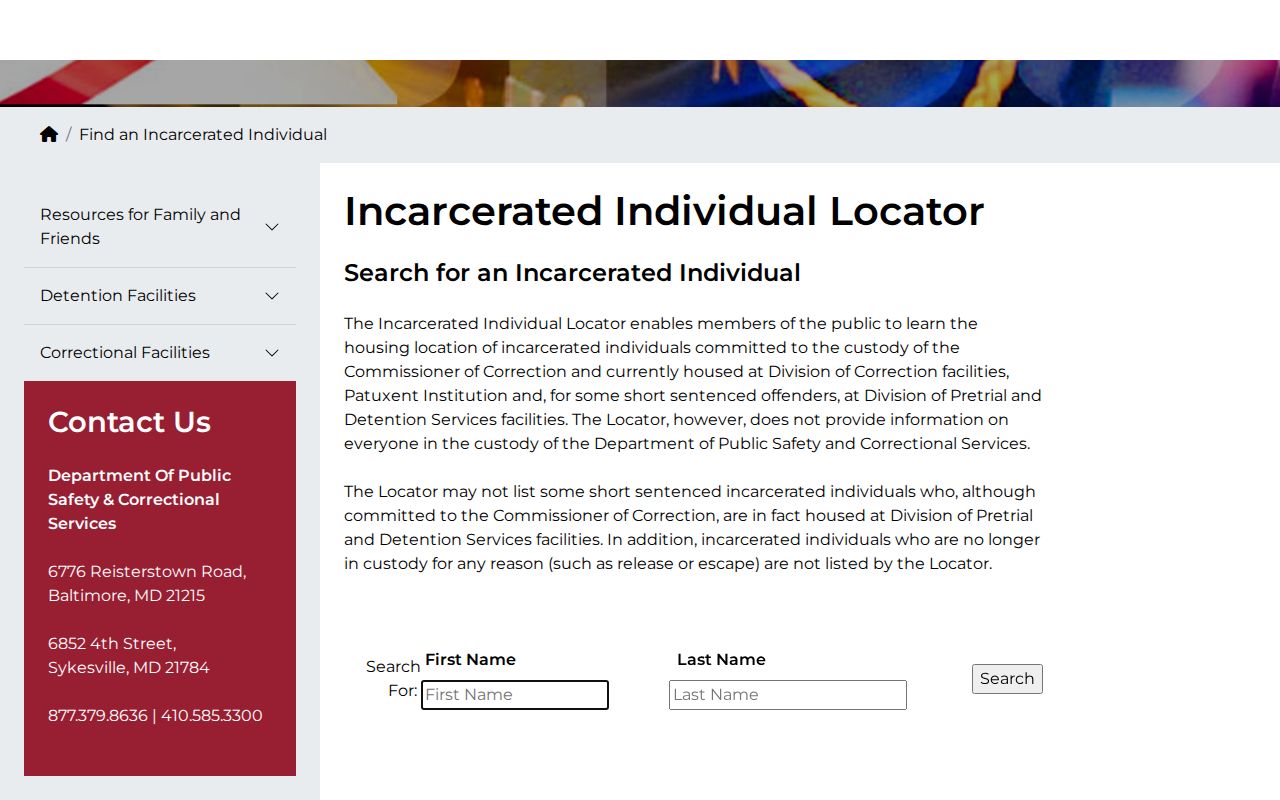
The captured warning is why a blank state search cannot be turned into an actual Cecil County release date. Use the sentence and release records instead.
Cecil County Pretrial Release Timing
A pretrial detainee usually has no sentence-based release date. The person may leave on recognizance, after bond is satisfied, after a dismissal or other disposition, or under a later court order. Another case, warrant, or detainer can prevent release even when one judge has authorized it. The question is therefore not a good-time calculation.
Maryland Case Search can show bail review, release conditions, commitments, detainers, and later docket entries. The docket explains legal authority, but it may not show the minute Cecil County Detention Center completes identity checks and discharge processing. Pair it with the local release entry. Review all related cases because one case can permit release while another keeps custody in place.
A transfer must also be separated from community release. Cecil County custody can end because the person goes to Maryland DOC, another jail, ICE, USMS, a treatment commitment, or another authority. Ask the local custodian whether a receiving agency is a releasable field. Then search that system. A present result there refutes the claim that the person is free in the community.
Note: A court order can authorize release before the jail completes its required identity, authority, notice, and hold checks.
Cecil County Local Sentence Credits
A locally sentenced person has a term, but the date is still computed rather than copied from the sentence length alone. Maryland Correctional Services § 11-503 grants five days per month of qualifying presentence confinement, prorated for part of a month. That period ends at sentence, commitment to the Commissioner of Correction, or release. Presentence credit under Criminal Procedure § 6-218 can also be awarded at sentencing for qualifying time already spent in custody.
Section 11-504 governs postsentence local good-conduct credit. Sections 11-505 and 11-506 address other work or project deductions, while § 11-507 permits revocation with due process. The actual Cecil County diminution report is especially useful because the Inmate Manual lists it among the Official Case Record categories a former inmate may request to review. A diminution report shows sentence deductions; it is not the same as the final discharge entry.
Presentence credit under Criminal Procedure § 6-218 is shown in a matching source capture.
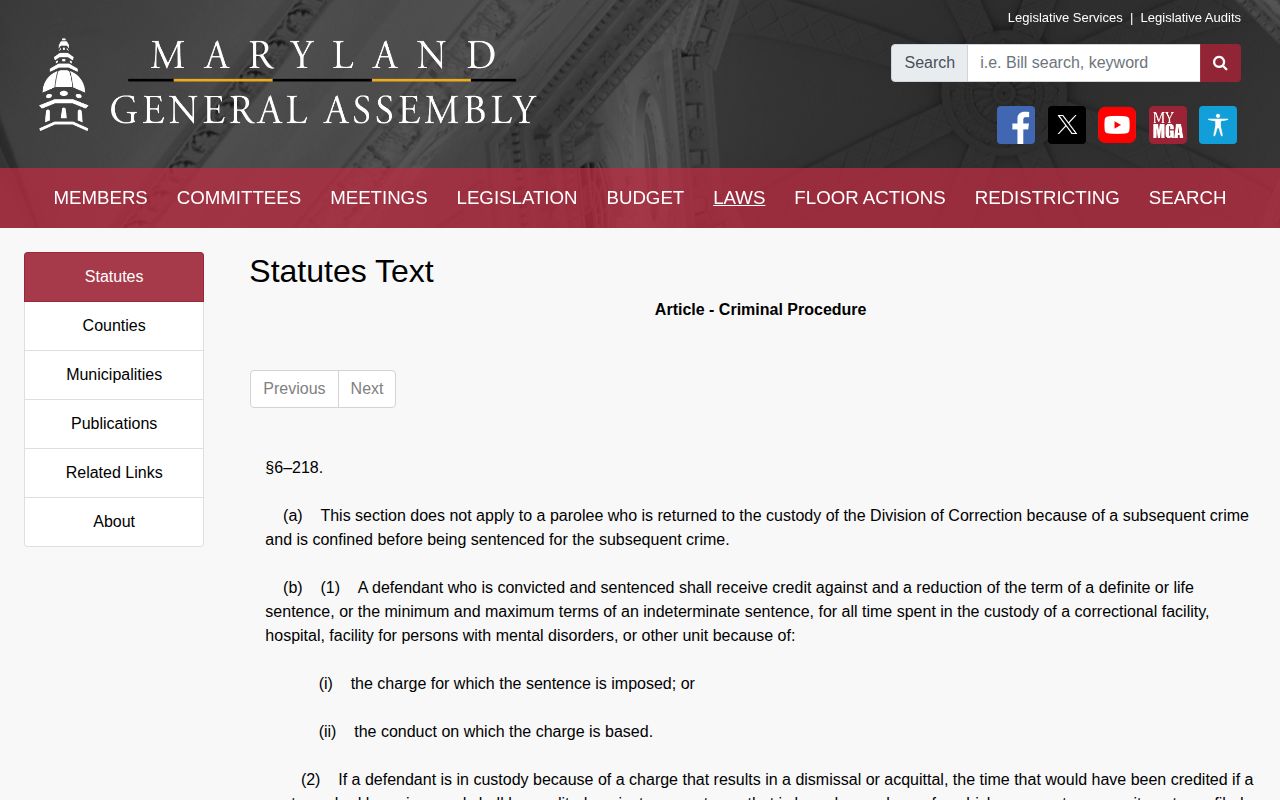
The statute image identifies the legal credit source. The signed sentencing record must show how qualifying time was applied in the individual Cecil County case.
For a former inmate's own record, a written request to the Warden may seek review of the Sentence Commitment, Court Orders, Detainers, Admission Summaries, Diminution of Sentence Reports, Parole Evaluation, and Parole Hearing Disposition. Public requests use the Sheriff PIA channel. The custodian applies any privacy, security, court, or other lawful limits.
Credit is counted within the governing sentence, not added as a free-standing promise from a calculator. Overlapping commitments, concurrent or consecutive terms, and a later court order can change which dates matter. The facility's computation and the court's commitment should agree on the sentence being served. When they appear to conflict, request the underlying documents rather than selecting the earlier date.
Maryland Credits Affect Cecil Releases
For a Maryland state prisoner, Correctional Services § 3-704 generally awards good-conduct credit in advance at ten days per calendar month. The rate is five days when the term includes a concurrent or consecutive crime of violence under the cited Maryland law or certain specified controlled-substance offenses. Partial months are prorated. Credit does not apply to a stayed sentence, escape, or certain time the Parole Commission declines to credit after revocation.
The official good-conduct statute is shown in the successful manifest capture linked above.
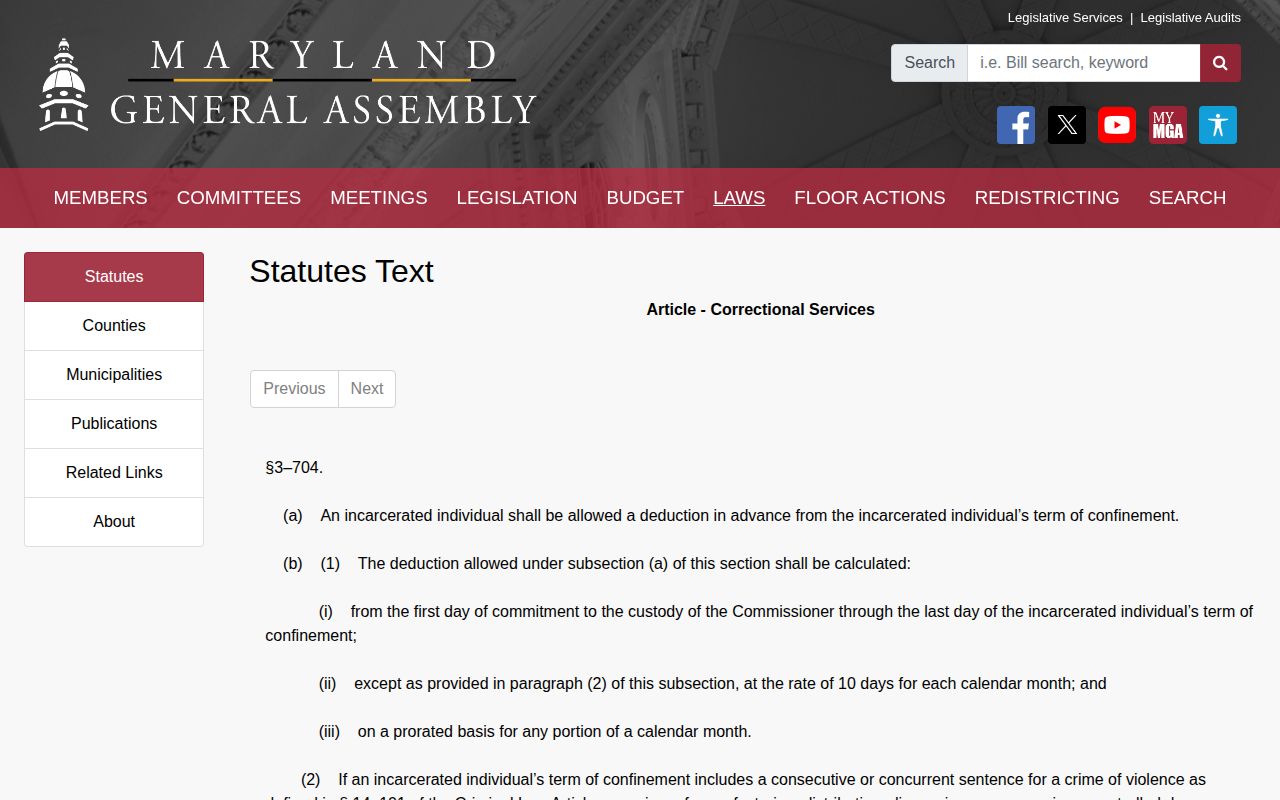
The statute provides one part of the calculation. It does not yield a dependable date without the actual sentence, offense classification, start date, and credit record.
Section 3-707 allows up to twenty days per month for satisfactory progress in designated work or programs, reduced to up to ten days for terms that include specified violent, registrable, or drug offenses. Other provisions govern education, work, aggregate limits, revocation, and restoration. Maryland does not have a general rule forcing every prisoner to serve 85 percent of the sentence. Limits tied to certain offenses must not be presented as a universal formula.
Note: Maryland has no universal rule requiring every prisoner to serve 85 percent of a sentence.
Cecil County Mandatory Supervision Dates
Mandatory supervision under Correctional Services § 7-501 conditionally releases an eligible person serving more than 18 months when the term less diminution credits has been served. For covered violent crimes committed on or after October 1, 2009, mandatory supervision cannot occur before parole eligibility. This is a conditional community release, not an unconditional end to all state authority.
The mandatory-supervision statute appears in the matching manifest image.
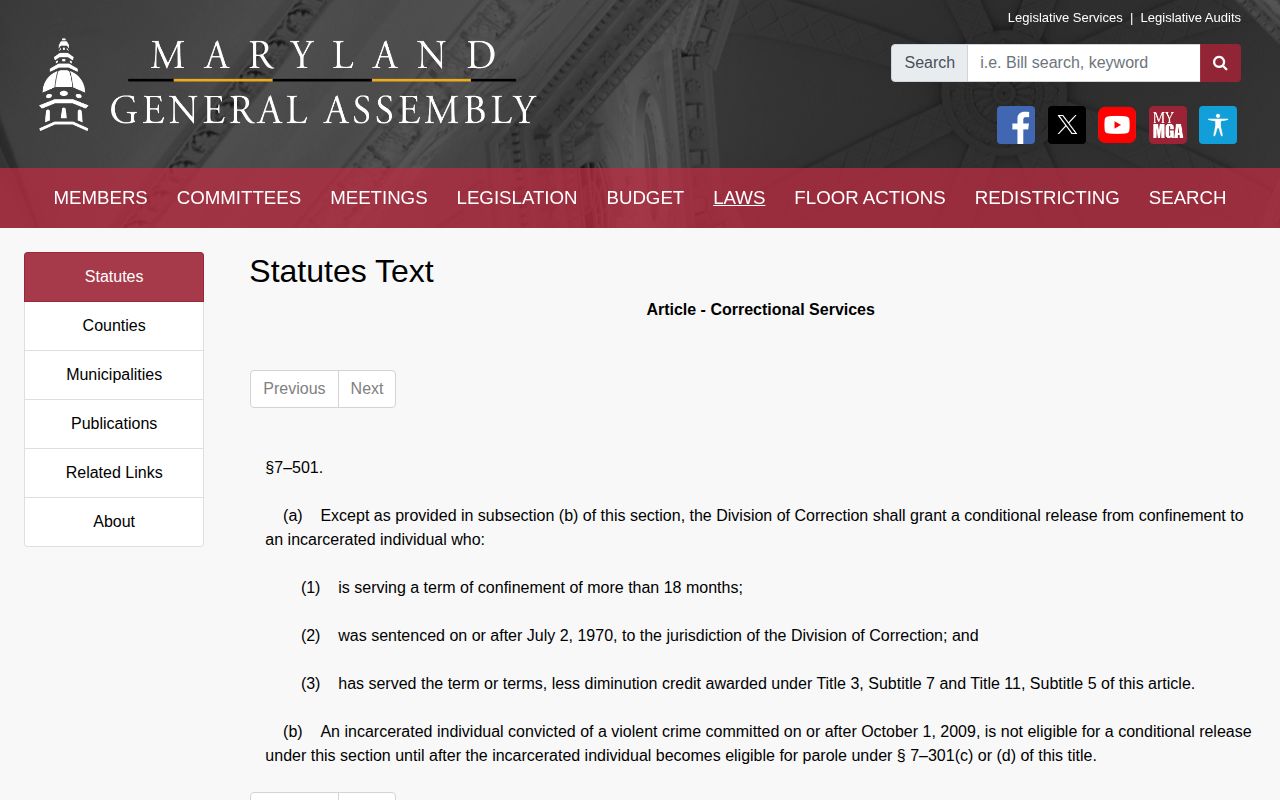
The statutory rule helps explain the calculation, while the person's sentence record and DPSCS credit history determine its application.
DPSCS Victim Services describes access to an expected sentence expiration date. That service is not a public locator field, and eligibility or access rules apply. An expected expiration also differs from a parole decision and from the actual release timestamp. When community supervision begins, the Division of Parole and Probation record becomes relevant to status after confinement.
What Changes Cecil Release Dates
No single figure stays accurate unless the underlying record stays unchanged. The court, correctional agency, and other custodians can each produce an event that changes the path. A useful date check records when each source was consulted and what authority it covered.
| Factor | Possible effect | Record to check |
|---|---|---|
| Earned or restored credits | Can move the calculated date earlier within the governing rules | Diminution or sentence calculation record |
| Credit revocation | Can move the calculation later after required process | Institutional credit and disciplinary record |
| Presentence custody credit | Reduces the remaining term for qualifying time already served | Sentencing order and commitment |
| Court modification | Can alter the term, suspended part, or authority for release | Updated court docket and signed order |
| Parole action | May approve, defer, or refuse conditional release | Maryland Parole Commission record |
| Detainer or transfer | Can end one agency's custody while another custody continues | Detainer disposition and receiving-agency record |
A parole approval is not the physical release time. The effective date, conditions, detainers, and institutional processing must still align. Likewise, a sentence expiration in one case does not resolve a second case. Every relevant commitment must be checked.
Note: A parole approval can precede physical release because conditions, detainers, effective dates, and institutional processing still must align.
Confirm Cecil County Actual Release
Use VINE for a pending custody alert, then verify the reported event with the named custodian. Maryland VINE can cover local detention, state prison, courts, and parole or probation records supplied by participating agencies. Registration should occur while the correct custody record is active. Users may need to re-register after a move between the local jail, state prison, court systems, and supervision.
The Cecil County VINELink Release Check explains the person search, phone PIN, and re-registration rule. A VINE event is notice, not the legal discharge instrument. Preserve it and request the Cecil jail entry, DPSCS release record, parole action, or court order that states the authority and destination.
For local history, ask Cecil County Central Records whether the past release entry requires a written request. A former inmate can use the Warden review route described in the Cecil County inmate manual. For a former state prisoner, the releasing institution or DPSCS Case Management Office for Operations at 410-585-3300 handles the person's own base-record path. Other requesters may use the applicable Maryland PIA process.
A narrow request is more useful than asking an agency to calculate a new date. Identify the person, custody period, booking or case number when known, and request the existing commitment, sentence calculation, diminution report, detainer disposition, and actual release entry. Maryland's Public Information Act reaches existing records but does not force a custodian to create a custom report or answer a new question. If part of a record is withheld, ask for the legal basis and any reasonably separable portion.
The final proof should answer five points: who was released, which custodian ended custody, the actual date and time, the legal release type or authority, and the destination or receiving agency. Without those fields, a projected date remains only a calculation.