
Maryland DOC Custody and Release
The Maryland Department of Public Safety and Correctional Services operates the Division of Correction as a statewide prison system. A Cecil County resident committed to the Commissioner may be held elsewhere in Maryland. That state commitment is distinct from pretrial or local sentence custody at the Cecil County Detention Center. Transfer from Landing Lane into DOC ends local custody but does not place the person in the community.
State custody can later end through sentence expiration, mandatory supervision, parole, a court action, or another legally authorized event. The release record should identify the person, releasing institution, actual date, release authority, destination, and continuing supervision when those fields are releasable. A parole approval is not itself the time the institution completes discharge. Detainers and processing can still affect the result.
Maryland's prison directory identifies no DOC prison physically in Cecil County. A local address, arrest, or court case does not change which agency owns the state prison record. Search and request records from DPSCS, then use the Cecil sentencing court when that court supplied the commitment. The county's Find an Inmate page points to VINE rather than the state DOC locator.
- Commitment
- The legal order placing a sentenced person in the custody of the Commissioner of Correction.
- Mandatory supervision
- A conditional release after the term less applicable diminution credits has been served.
- Discharge
- The documented end of the relevant custody or supervision status.
Maryland DOC Current Custody Locator
Maryland calls its public search the Incarcerated Individual Locator. It identifies the facility location of covered people currently committed to the Commissioner and housed in Division of Correction facilities, Patuxent Institution, and some short-sentence Division of Pretrial and Detention Services settings. The visible search fields are first and last name. Some short-sentenced people are not listed.
The most important limit is explicit. People no longer in custody for any reason, such as release or escape, are not shown. The locator does not offer a persistent released result, an actual release date for a former prisoner, a parole or probation status, or a public projected-date field. A missing name can also reflect coverage, spelling, a transfer lag, or another custodian.
The official locator and its released-person warning appear in the matching manifest capture.
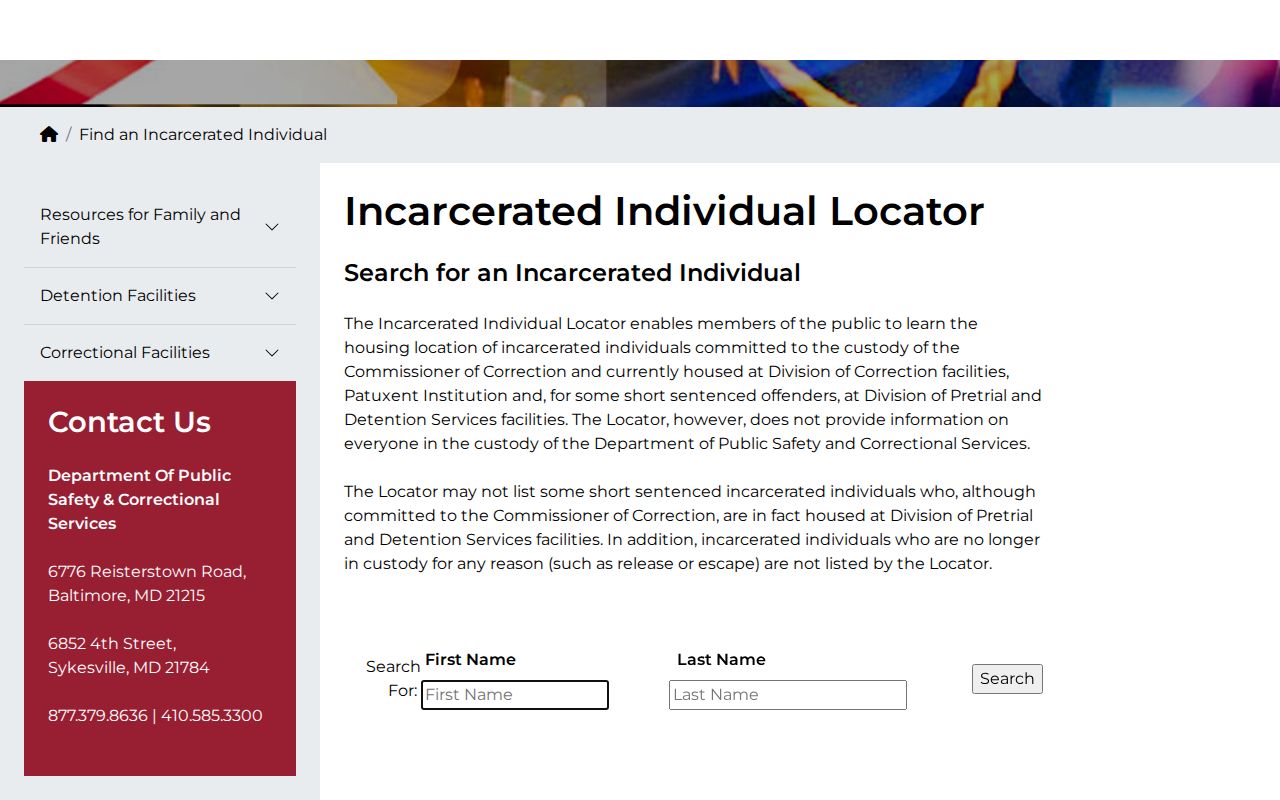
This screen is useful for identifying present state confinement. Its blank result cannot prove release and must lead to court, VINE, parole, supervision, and DPSCS record checks.
Note: The public DPSCS locator identifies covered current custody and does not retain a released-person result or actual release date.
Confirm Maryland DOC Release Records
A state release is strongest when the institutional event is paired with the legal authority behind it. Start with the sentence, then locate the agency record that shows what happened. Keep the check date because custody can change between searches.
- Search the DPSCS locator. A matching current result confirms covered state custody at the listed facility.
- Review every related Maryland sentencing case for the commitment, sentence, custody credit, later modification, and detainers.
- Search VINE and preserve any release or transfer event tied to the correct state record.
- If parole applies, consult the Maryland Parole Commission action and confirm its effective conditions.
- If community supervision may be active, contact the Division of Parole and Probation and ask what status can lawfully be confirmed.
- Request the existing DPSCS commitment and release record for the actual date, authority, sentence-expiration information, and destination.
This chain separates three issues. The locator addresses present covered custody. The court and Parole Commission explain legal authority. DPSCS owns the state institutional record, while DPP addresses supervision after release. The Cecil County release search and record hub covers the county and other custodians when the state record does not resolve the full path.
Maryland DOC Records and Contact
A former state prisoner or an authorized representative seeking the person's own base record should contact the releasing institution or the DPSCS Case Management Office for Operations. Other requesters may use the department's Maryland Public Information Act route. Requests should name existing records rather than demand a new calculation or custom report.
Maryland DPSCS6776 Reisterstown Road
Baltimore, MD 21215
Case Management Office for Operations: 410-585-3300
General toll-free line: 877-379-8636 DPSCS Public Information Act Requests
Office of Constituent Services
6776 Reisterstown Road, Suite 212
Baltimore, MD 21215
Email: dpscs.pia@maryland.gov
Ask for the existing commitment, actual release date, release authority or type, sentence-expiration information, and destination or receiving agency. DPSCS says the first two hours of search and preparation are free. Copies above two pages are listed at $0.50 per page, with possible certification, postage, and prepayment charges. The agency need not create a list that does not exist.
Maryland DOC Release Date Calculations
An expected sentence expiration date is not the same as parole eligibility or actual release. DPSCS Victim Services describes access to expected sentence-expiration information under its rules, but that information is not displayed on the public locator. Correctional Services § 7-301.1 separately uses tentative release eligibility date for administrative-release planning. The terms serve different purposes.
Maryland state good-conduct credit generally begins at ten days per calendar month under § 3-704, with five days for terms that include certain violent or specified drug offenses. Section 3-707 permits other credits for satisfactory progress in designated work or programs, subject to lower limits for listed offense categories. Presentence custody credit under Criminal Procedure § 6-218 can reduce the term for qualifying time already spent confined.
Credits may be earned, revoked, or restored. Courts may modify sentences. Parole action and detainers can intervene. Maryland does not impose a universal rule requiring every prisoner to serve 85 percent of the sentence. The actual date must come from the individual calculation and final release entry, not a generalized percentage.
Note: A date from Victim Services, a parole eligibility calculation, and an actual DOC discharge date are three separate records.
Maryland DOC Parole and Supervision
The Maryland Parole Commission decides parole matters. The Division of Parole and Probation supervises parolees, probationers, people released on mandatory supervision, and certain monitored cases. Probation can arise from a court sentence without a state prison release, so it should not be described as parole. No public name-based DPP client or absconder search was found.
A Parole Commission approval can set a path toward release, but the effective date, conditions, detainers, and institutional processing still matter. The Commission's public meeting calendar is not a searchable person-by-person hearing docket. Registered victims may receive hearing and result notices through Victim Services, while other access depends on the applicable Commission contact and records process.
After release, active supervision should be verified through DPP and the controlling court or parole record. An alleged warrant, violation, or absconder status is not a new conviction and does not prove a new arrest. Check the issuing authority, current status, and possible custodian separately.
Maryland DOC VINE Release Alerts
Maryland VINE covers the Division of Correction as well as local detention, courts, parole, and probation records supplied by participating agencies. Search by the person's name or offender number, compare the agency, and read only the custody status, location, and date fields that the chosen record displays. Exact wording and record persistence can vary.
Notification registration works best before release. Offered methods can include phone, text, email, TTY, or app delivery. Phone registration uses a four-digit PIN, and Maryland's operational brochure directs the user to enter the PIN followed by the number sign when the automated call arrives. That confirms receipt and stops repeat calls.
A move from local detention into state prison may require a new registration. Another registration may be needed when the person enters parole or probation. The alert follows the agency or system record rather than a permanent person-level history. Preserve each event and use the DPSCS release record when the exact legal type or destination matters.
Maryland DOC Transfer Boundaries
DOC release means the person left the custody shown by Maryland's state prison record. It does not always mean unrestricted return to the community. A detainer can direct a transfer to another jail or authority. Federal custody may require a BOP, ICE, or USMS route, and a court case may support confinement independent of the completed Maryland term.
A Cecil County local release entry cannot certify the later state discharge, just as DPSCS cannot certify a county jail record it does not own. Match each claim to its custodian. If the state record says transfer, identify the receiving agency. If it says parole or mandatory supervision, verify the community status. If the person is simply absent from the locator, keep searching. Use the Sheriff's request route only for the local entry.
| Question | Best record |
|---|---|
| Is the person in covered Maryland prison custody now? | DPSCS Incarcerated Individual Locator |
| Why was the person legally released? | DPSCS release record plus court or parole authority |
| Does supervision continue? | DPP, parole record, and sentencing court |
| Did another custodian receive the person? | Transfer entry and receiving-agency record |
Note: A transfer ends one custodian's control only when the receiving agency assumes custody; it does not necessarily mean community release.